By KOPANO MONAHENG
MZANSI children have first-hand experience of poverty, drug abuse and other social challenges.
For many, a lack of food and education mean they remain trapped in poverty.
And that’s what KFC wants to stop.
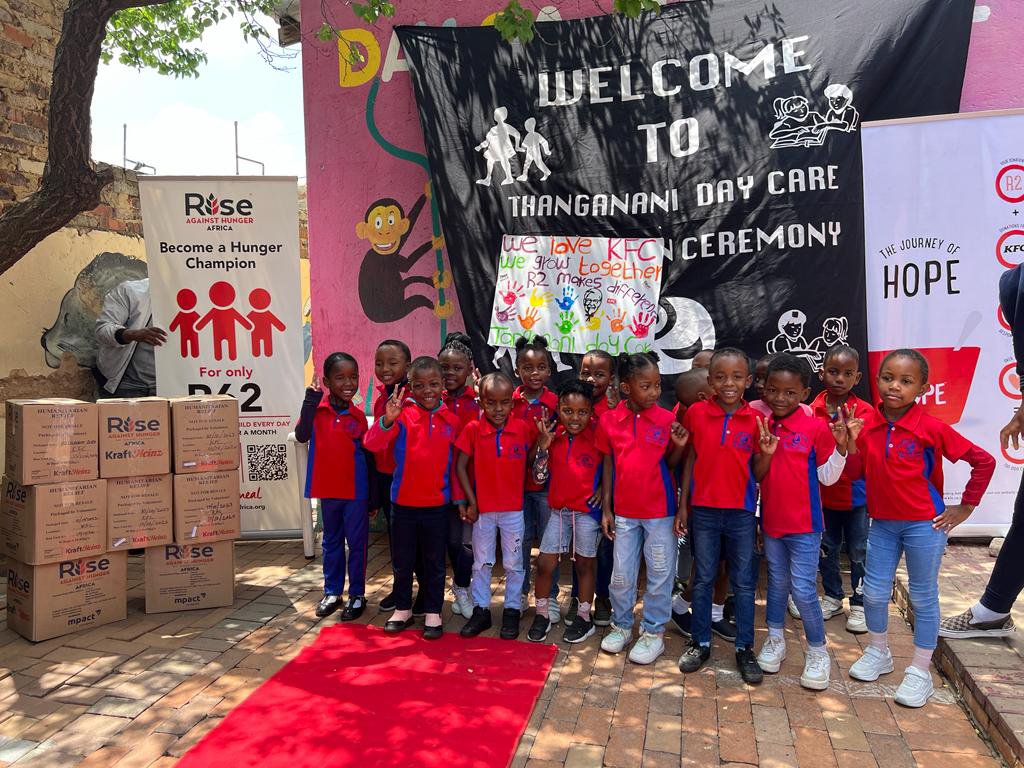
The most loved fried chicken giant is going around Mzansi to provide children at early childhood development (ECD) centres with food and learning materials.
Through KFC’s Add Hope, customers are asked to donate R2 every time they buy meals at their outlets. The money then goes into buying food for less privileged children in ECD centres across Mzansi. This has been KFC’s project since 2009.
To date, Add Hope has provided over 318 million meals, supporting more than 134 different non-profit organisations across all nine provinces, Rise Against Hunger is one of the beneficiaries.
Andra Nel, marketing manager for brand and purpose at KFC, said this year, the food outlet, together with Rise Against Hunger Africa, have managed to package 35 000 meals.
Each parcel contains various staples like dehydrated vegetables and vitamin sachets.
“The 35 000 meals will feed 152 children, five meals a week for an entire year while attending their ECD facility,” she said.
Two of the many ECD centres they are supporting include Tangani in Diepsloot and Elelwani in Ivory Park.
“Our ECD Connect programme takes on unregistered ECDs and helps them improve their facilities, build educational infrastructure, teacher training and health and safety standards. This is achieved through the savings created by providing them with meals sponsored by KFC Add Hope,” added Nell.
She said people should not underestimate the forever rising food prices as it has a negative impact on the lives of people, especially those living in poor communities. This also has an impact on health, child development, social and mental well-being.
She believes that no child should go to bed hungry, and no child should be deprived of a good education.
“Through collective and continued efforts, along with government support, we can feed our future potential,” Nel said.
Acute food insecurity in Africa has increased by over 60% in the past year and threatens to widen even further, especially if we consider rising inflation and food prices as well as the fact that overall inflation rate in sub-Saharan Africa is expected to grow to 12.2% stretching consumers’ pockets even further. South Africa also continues to experience some of the highest levels of inequality in the world and the scope of food-insecurity and hunger are a major concern.
As we commemorated World Food Day on 16 October, it was important to highlight that access to food is crucial and that partnerships with purpose can make a difference.
Brian Nell, CEO of Rise Against Hunger Africa agreed that many parents have been struggling to pay for their kids’ school fees due to high inflation.
There is also an increase in requests for “take home” meals for the families whose children attend the ECD centres we serve, placing more pressure all round.”
Their ECD Connect programme takes on unregistered ECDs and helps them improve their facilities, building on educational infrastructure, teacher training, health and safety standards.

 Site Title