EVERY year during this time we tend to spend more money.
We know festive season is just two or three weeks of fun, and after that it is back to hard days again.
But we still keep doing the very same mistake we did a year ago of overspending money carelessly.
But one Mzansi’ largest bank wants to help you do the right things. The African Bank has shared some tips to say don’t forget your beginning of the year resolution when it comes to budgeting.
, Set Limits on Gift Spending
Think of meaningful gifts such as experiences, charitable donations or subscriptions. Sometimes, meaningful experiences can be more valuable than material gifts.
, Consider Alternatives
Whether you’re shopping at some of your favourite stores, explore alternatives to traditional brands and essentials.
Track Your Expenses
Keep track of your spending to ensure you stay within your budget.
Bargain buying
Be on the lookout for discounts, sales and promotions.
Smart shopping can help you make the most of your money and stretch your budget further.
Something terrible is happening in our beloved townships these days. And it is cause for concern.
It involves children, and adults buying and consuming food from spaza shops owned by foreign nationals of Indian descent – Pakistanis and Bangladeshis – who are called, abo my friend.
What used be a black-owned market back in the day, is now 99.9% dominated and controlled by these illegal foreigners. Profit earned from the sale of the illicit goods sold by “abo my friend” is shipped out of the country illegally on a daily basis. A valuable market is slipping through our hands sibhekile, and no one in government is doing anything about it.
Research shows that currently there are 150 000 spaza shops throughout the country. They are competing with industry players Shoprite (3 152 stores) and Pick N Pay (2 000 stores).
It is reported that 80% of the population visits a spaza shop each day, 40% of food is bought from spaza shops daily, and 70% of bread is sold at spaza shops daily. The number-crunching shows that the spaza shop market is worth R178 billion.
Given the above figures, Tax Justice South Africa (TJSA) and the SA Revenue Service say illegal spaza shops cost the country’s fiscus billions of rands.
“If it were not for the increase in illicit goods being sold on the streets, at tuck shops, or any other areas, the country’s fiscus could afford another R12bn for education, R6.5bn for health, and an additional R6.5bn for community development,” says TJSA. The production and sale of fake foods and products is not a new phenomenon.
In 2018, police in the Northern Cape arrested five men and a woman for producing counterfeit sanitary towels, shoe polish, food and other illegal items.
What happened to the corner stores ikasi used to pride itself in? The Nkosi & Sons, the Mofokeng, the Mashini, the Moloi stores, ndibala ntoni, are dead and buried. They have been replaced by these thugs, all in the name of making easy money through renting out space.
Now and then, we hear stories of children getting sick or dying after consuming food stuffs bought from these manga manga shops.
These food items have either reached their sell-by dates, are rotten, they do not comply with or meet regulated food and health standards, and are also not meant for human consumption. They are manufactured from dingy and filthy factories in some remote area of the country.
Inspectors from the Department of Health, whose duty is to go around checking the quality of the food we consume, monitor and regulate these spaza shops, are visibly sleeping on the job.
To start with, these foreigners have no proper places to stay. Therefore, a shop by day, turns into a sleeping area by night. The concept of hygiene and cleanliness is thrown out of the window.
And like clockwork, the next day you see the local community queuing up in front of these dark, dingy, stinky and filthy shops. Social media is awash with stories of mass production hubs of fake beans, packaged as Koo beans, fake cornflakes, spaghetti, noodles, cough syrup, fake cool drink such as Lemon Twist and Coca-Cola, milk, and Grand-Pa medication for headache, condoms are recycled from used ones or fake condoms branded as Lovers Plus condoms and fake cigarettes.
Children are sold fake or allegedly poisoned biscuits, Go Slow chips, and all other junk you may think of. Sadly, some kids die after consuming these illegal food stuffs.
These fong kong food materials are challenging the already- existing brands and products that we know and grew up with. Following the death of the four children in Soweto, the West Rand and other areas recently, Operation Dudula and civil rights movement, Not In My Name International, have been agitating for the closure of spaza shops operated by undocumented and illegal foreigners in all Gauteng townships.
O kae molao to raid and shut these spaza shops once and for all? Communities are urged to make it their business to fight for the elimination of foreign-owned spaza shops in their areas. Government and leaders are sitting on their hands while our kids are dying. Sadly, our townships and our legacy have been sold to the highest bidders, literally
Tsotsis are not driven by moral justification or logical reasoning whenever they execute their acts of violence.
This time, they have outdone themselves. Just when you think they have mastered the art of car hijacking, bombing ATMs and robbing cash-in-transit vehicles on the highways and byways, they seem to have upped the ante in implementing their dastardly deeds.
Thieves now regard church buildings and worshippers as “soft targets”. Now, their modus operandi includes attending church services posing as worshippers and then pulling out firearms, to the shock and horror of those attending.
They demand money – because they had a tip-off that there was a Thanksgiving Day the past week in the church. They ransack the house of the Lord, take TV sets, laptops, music equipment, wedding rings of the worshippers, cellphones, jewellery and wallets and make a run for it. Some cases end up in assault, kidnapping and murder. This has left many congregants traumatised.
Church gatherings are seen as “easy targets” by izigebengu because congregants focus entirely on worshipping. The faithful regard church buildings as sacrosanct and tithe in cash. Getting attacked is the last thing on their minds.
In one horrific incident, a church elder was taken hostage and released later after a ransom was paid. In another, tsotsis were frustrated by the low amount of the loot they got and decided to shoot church attendees. This resulted in the death of one church member.
These incidents have been recorded in and around Boksburg, Rosettenville and Doornfontein in Gauteng.
The recent murder of Pastor Dwayne Gordon during a church service in Joburg is but one incident that has bedevilled the church. Police are still on the lookout for the perpetrators of this violent incident. In another church in Tea Estate, Verulam, on the KwaZulu-Natal North Coast, a pastor was also held at gunpoint while preaching.
These spine-chilling incidents have led some churches to cancel evening services. Others have opted for private security measures and installing CCTV cameras and are encouraging members to leave their cellphones, purses, or wallets at home when attending services. Congregants have been encouraged to tithe via online payment systems and using digital platforms.
Criminals also find it easier to go after ‘easier’ targets such as university students or low-income earners who will not draw media attention for smaller ransoms. Private security companies have issued a warning about the growing number of kidnappings.
With the rising number of criminal acts in churches, leaders of over 1 500 churches in Gauteng have called a meeting with Gauteng Community Safety MEC, Faith Mazibuko, to raise their concerns and find solutions around what seems to be a powder keg waiting to explode. The South African Council of Churches has also raised its voice on the increasing bloodshed during church attacks.
While it seems as though churches are the main targets, the rise in criminal incidents is a reflection of the worsening crime conditions in communities.
The attacks on churches is just but a microcosm of a bigger problem facing Mzansi in the run-up to the national poll in 2024.
The latest crime statistics that cover the first quarter of the 2023/24 administrative year (April to June 2023) indicate that despite a dip in reported incidents in general, the number of violent crimes, including assault, murder and attempted murder, continue to escalate. Robberies with aggravating circumstances that involve the use of weapons, in which victims face danger, have also skyrocketed.
Criminals are brazenly focusing on specific groups and targets as they keep communities under siege. Churches have been advised to work with community policing forums to protect the areas where worshippers congregate.
Congregants are also urged to be each other’s keepers and identify potential criminals whose aim is to infiltrate communities and churches. With churches now caught up in the mix, the places where South Africans go to seek solace from the crime onslaught and violence, worshippers now find themselves having to seek other ways and means to protect themselves from criminals.
Home deliveries and drivers have also become prime targets for the goods and the vehicles they use. Drivers are also robbed of their personal belongings, including wallets, cellphones and cash. Hijackers now find kidnapping their victims for a ransom as a lucrative option.
Criminals seem to give the SAPS and its motormouth leader, Bheki Cele, a finger while he barks like a toothless dog as they carry on with their dastardly deeds.
It is disconcerting for Cele, his commissioners and deputy commissioners to stand on platforms and regurgitate empty promises as part of their PR exercise while people are at the coal face of crime daily.
Congregants and communities are calling for tough action against these heartless evil-doers who seem to be holding the entire nation to ransom.
Churchgoers want to be left alone in peace, and to go about their Sunday business of worshipping
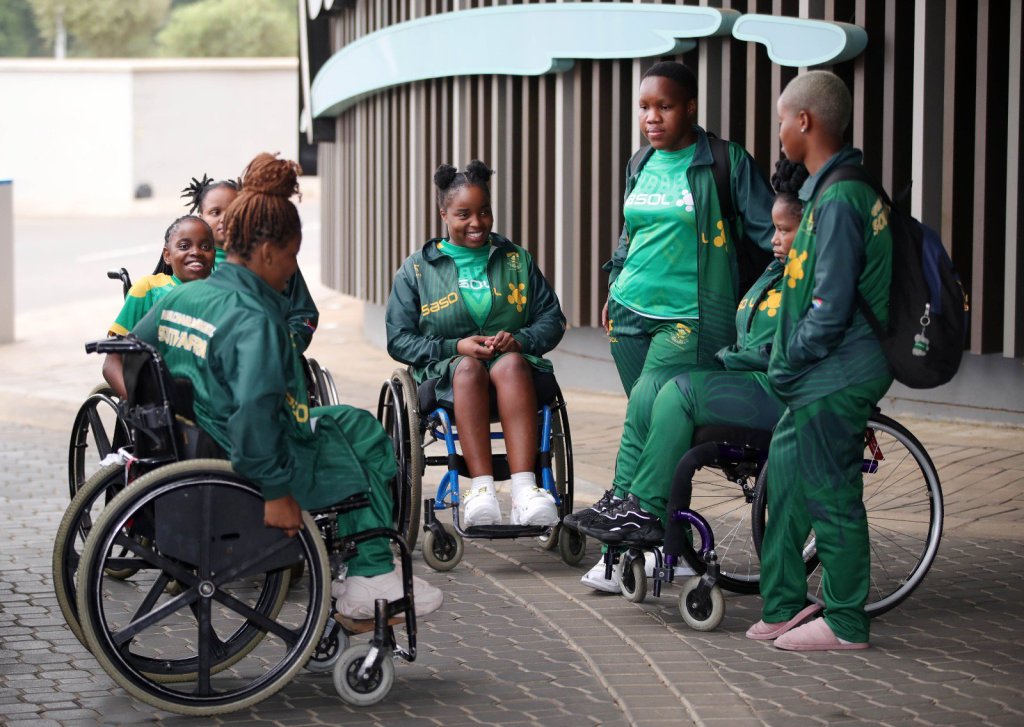
YOU may not know what you’re capable of doing until you try basketball.
Dean Somerset, who is brand and sponsorship manager at Sasol, said sports isn’t just about careers and money.
He said people can improve their physical ability and skills, their self-esteem, social skills, and confidence by taking part in sport.
While it is also a hobby, sport teaches people about time management and discipline.
As we come out of National Disability Awareness Month (3 November – 3 December) it is important that people do understand the importance of people living with disabilities in Mzansi.
For the last 30 years, a lot has been achieved to ensure the rights of people living with disabilities are respected in the country.
He said there are now buildings that are disability-friendly, not just for people in wheelchairs but even for those who are visually impaired.
A disabled person feels excited, joyful, and full of energy when they get recognition for what they do.
Sasol hosts events to help create public awareness and educate about the rights of people living with disabilities.
Last weekend, they commemorated a National Disability Awareness Month through concrete action.
Khune At the conclusion of the Club’s rigorous disciplinary processes last week, the committee has taken stern action and decided that Itumeleng Khune should be temporarily separated from the team until certain conditions have been fulfilled.
As a Club that upholds the highest levels of professionalism, in which discipline forms a key component, Kaizer Chiefs initiated an internal investigation after certain incidents involving Khune came to our attention.
The investigation was essential in ensuring the proper functioning and unity within our team.
During his absence, Khune will be expected to attend and actively participate in certain programmes designed to support his personal growth and development, with support from the Club.
These programmes are specifically aimed at helping him address challenges and issues he is facing, while promoting a positive team culture.
The Club has taken steps to address his transgressions and certain sanctions were instituted, including removing him from the Club captaincy of Kaizer Chiefs.
As Kaizer Chiefs, we believe in applying corrective measures to achieve personal growth, and we are committed to providing the necessary support to Itumeleng during this period.
Once he has completed the required programmes and met the set expectations, he will be welcomed back into the team. The team remains focused on the upcoming fixtures and the continued pursuit of excellence.
We have full confidence in our players and coaching staff to maintain our high standards and achieve success in Khune’s absence.
Kaizer Chiefs would like to assure everyone, including our supporters that we remain committed to our core values of discipline, integrity, respect, and unity.
We appreciate the unwavering support of our loyal supporters and encourage them to stand together with us as we navigate through this challenging.
FINDING out about your HIV status in the 90s down to early 2 000, was like a sour pill to swallow as most people were highly stigmatised. . .
With more education and research a lot has been achieved.
Today people living with HIV can live longer, provided they take their medication regularly, while the fight to find the cure is ongoing.
As the world observed World AIDS Day on December 1, is to remind people that they need to take care of themselves and practice safe sex.
AIDS Healthcare Foundation (AHF) South Africa commemorated the day with the community of KwaMashu and the surrounding areas in KZN to raise more awareness around HIV /AIDS.
This year’s focus was to raise awareness about the epidemic, honour those who have lost their lives to AIDS-related illnesses, support those who carry on the fight, and unite people globally in battling HIV/AIDS.
Dr Kate Ssamula, country program director at AHF South Africa, said that people living with HIV are at the heart of what they do.
“We are celebrating a diverse group of people who make up this community and celebrating the HIV allies who stand shoulder to shoulder with them and fight for HIV rights while celebrating the milestones that have been achieved over the years,” she said.
While the world has made significant progress over past decades, the global HIV/AIDS response faces serious threats, including insufficient funding, dangerously high rates of 1.3 million new HIV transmissions annually, an estimated 630,000 deaths each year, and responses not being prioritised highly enough, particularly in lower-income countries.
To give significant meaning to South Africa’s theme for this year’s World AIDS Day – Let Communities Lead – there has been numerous events commemorating AIDS day in the Butterworth, Mnquma Sub-district in Eastern Cape and Diepsloot, north of Joburg, Gauteng until December 8.
“World AIDS Day provides a platform to emphasise the urgent need for decisive action against HIV/AIDS in South Africa, especially among young women and girls.”
AHF says it’s crucial to address the rising HIV infections, especially in the context of intersecting issues like GBV and teenage pregnancy. And the emphasis globally is on empowering young women and girls to ignite change.
Scientific advancements in HIV research and treatment have been pivotal in improving the lives of individuals living with the virus.
Innovations such as antiretroviral therapies, preventive measures like pre-exposure prophylaxis (PrEP), and groundbreaking vaccine development continue to reshape the landscape of HIV/AIDS prevention and care.
A survey conducted by the Human Sciences Research Council (HSRC) with its partners in 2023 released findings from the Sixth South African National HIV Prevalence, Incidence, and Behaviour Survey (SABSSM VI), found that the percentage of all people living with HIV in South Africa has decreased from 14.0% in 2017 to 12.7% in 2022.
This translates to approximately 7.8 million people living with HIV in South Africa in 2022 compared to 7.9 million in 2017.
We urge all South Africans to always recognise HIV/AIDS as a chronic illness that can be managed and that people living with HIV may live full and happy lives.
“We all have a responsibility to treat individuals who have an HIV-positive diagnosis with compassion, those who have AIDS with care, and ourselves and our sexual partners with dignity,” said Kate.
Addressing stigma and discrimination is critical to reducing the burden of HIV. She said world AIDS day is commemorated annually to remind people that the battle to find a cure for aids is on.
I’m flabbergasted, livid, utterly astonished, shaking with disbelief, and at a loss for words. My anger is palpable, to say the least.
Thank goodness, I have a chiskop. Otherwise, I would be tearing my hair out as I draft this piece.
The other day, I read a worrying story about Gauteng Premier, Panyaza Lesufi, contemplating some nonsensical plan to “improve” kasi taverns and to turn them into “taverns of the year” and “safety zones”.
Lesufi said on X (formerly Twitter): “Today, we received a full briefing to launch taverns of the future in our communities. The tavern of the future will blow your mind! Thanks to the new Heineken Vision. Exciting times indeed.” #GrowingGautengTogether “Investment is above our individual preferences. We must bring investments in our province to create jobs and opportunities for all.”
He announced this after his office received a briefing from the beer-making company, Heineken South Africa, outlining this startling plan “to rebrand taverns”. What a load of bull.
Is Lesufi out of his mind? Is he smoking his socks or is he inebriated? I think, the latter aptly describes his state of mind when he made this announcement. How, on earth, do you allow such? Lesufi’s pipe dream really boggles the mind.
This is a U-turn by someone who, in 2019, vigorously declared: “The sooner we realise that this drug called alcohol is destroying and ravaging our nation, the better. I fail to understand why people worship this drug.
“The problems of alcohol are real. This problem of alcohol needs brave soldiers, not the faint-hearted. An alcohol-free South Africa is possible, let’s build it now.”
In 2020, Lesufi once again pontificated: “I differ, strongly on the use and sale of alcohol. I’ve stated this view before. This drug is costly and ruthless and should be defeated. It has no value in building a healthy society.”
He also started a campaign called #AlcoholFreeSA, which was aimed at decreasing the abuse of alcohol in our communities. Now that Heineken is poised to take over the township economy, Lesufi is singing politics of the stomach.
According to Creamer Media’s Engineering News, the Heineken South Africa initiative involves the transformation, including building, construction, business and diversification support, of neglected tavern facilities, “as well as monetary investment in developing the taverns’ offerings”.
I need to be persuaded otherwise on this one. This highly acclaimed initiative will not, in any way, help tavern owners. Instead, it bears all the hallmarks of turning them into vagrants and deny them control over the kasi economy.
Have we not learned from the spaza shops that illegal foreigners have since taken over? I fear the worst.
I fully agree with Afro-pop singer, Thandiswa Mazwai, that Lesufi is “counter-revolutionary”.
Even some of his colleagues in the government are critical of this initiative.
Department of international relations and co-operation head of public diplomacy, Clayson Monyela, joined the conversation.
“My dad was murdered at a tavern in Kagiso. He was 33. Taverns traumatise me.
“My heart breaks when I see companies like Heineken getting endorsements from my government to expand further into our communities. The few ‘jobs’ they’re promising is not worth the thousands of lives these people are going to destroy. This is good for Heineken, not for us. I’m so pissed!” said Monyela.
Has the premier been living under the rock? He seems oblivious to what the abuse of booze has done to black life.
The National Liquor Traders Council welcomed the initiative. But that is a story for another day.
Everywhere you turn ekasi, you are met with big billboards, walls, TV and other forms of media advertisements promoting this killer drug, on the one hand. On the other, taverns and shebeens are all over the show. Some are found in close proximity to schools and crèches. Now, Lesufi sees their promotion as the best thing under the sun.
Research is littered with data that puts alcohol abuse as the number one cause of some of the existing societal problems facing many families today.
Communities report that alcohol-related trauma, exceptionally high rates of TB, child and adult malnutrition, and Foetal Alcohol Syndrome are some of the major concerns bedeviling our communities.
In addition, social problems associated with alcohol, including drunk driving, child abuse, violence against women, and family disruption are obstacles to the government’s health and social services.
It is said that alcohol is a gateway to drug abuse. Bored young people end up passing the time by using booze, nyaope, drugs and other toxic and deadly substances.
“The tavern of the future is only here to cement the destruction of black people,” said Thandiswa.
Mr Lesufi should be reminded about when and how this booze problem all started.
Old folks were rudely introduced to this evil through the dop system (a payment method in which agricultural workers were paid for their hard labour in alcohol instead of money).
The ramification of the dop system is the perpetuation of poverty in mainly Coloured farm worker communities. It has created generations of disadvantaged youths and abused women due to alcohol dependency.
Now, Lesufi and his Heineken cohorts want to make us believe that taverns can be turned into safety zones. Pull the other one, Mr Premier.
Have you forgotten what happened at Enyobeni in the Eastern Cape, Orlando East’s Nomzamo informal settlement, Katlehong and Pietermaritzburg? To date, some of the perpetrators of these evil acts are still to be apprehended and the families who lost loved ones want closure. What is in it for you, Mr Lesufi?
We should not only focus on taverns in a particular context with a history of violence. Amakasi are violent by design. Taverns and shebeens are a reflection of the colonial-apartheid racialised spatial make-up. Are there taverns and shebeens in white residential areas?
Today, there are many non-profit organisations whose programmes are aimed at helping to cushion the impact and dependency of alcohol across Mzansi. Why not finance them in their various attempts to beat the menace of alcohol abuse?
Why not use the money earmarked for this “booze programme” for social upliftment projects?
Townships are in desperate need of libraries, soccer fields, art centres, schools need science labs, the list is endless. As we speak, the Joburg Library has since shut down due to financial constraints.
Stop throwing money into wasteful projects. Our children’s future is at stake. Let us avoid raising the so-called lost generation.
Come to think of it, such madness can only happen in South Africa where immorality is promoted and put on a pedestal, regardless of the consequences.
Mr Lesufi, no bright future has ever been built by promoting alcohol. It is clear as daylight that your aim is to keep the investors happy, even if it means increasing access to a drug that is costly, and ruthless to those you claim to represent. Have you no shame?
How do you sleep at night knowing that you and your organisation are responsible for the killing and destruction of your kin through this intoxicating beverage?
In the new year, I shall be following developments in this so-called Heineken tavern safety zone pious claptrap and the flip-flopping Lesufi like a hawk.
ALL that Summerose Nyembe wanted was to avoid depression, anxiousness and stress.
However, these emotions are often our unwanted companions.
The 20 year-old model from Dobsonville in Soweto, was the last man standing at this year’s Mr and Mrs Mzansi International.
Her crowning took place at the glamorous Roodepoort City Hall over the weekend.
Nyembe, like many of her competitors, knew that partaking in bigger competitions meant that one either won or lost.
“To be honest with you, I did not participate in the competition to win it, but to enjoy every moment of it,” said the modeller, who is studying Film & Television Production with the VMC Academy.
She said to avoid disappointment in your life, one needed to take things easy.
She competed against the best, which made the victory all the more gratifying.
The aspiring actress went into this competition without any expectations and that’s why she broke into tears when she was announced the overall winner.
Her modelling career started three years ago and this win was her biggest win of her life.
KMP Foundation was the main sponsor and organiser of the annual Mr and Mrs Mzansi International.
The foundation CEO and founder, Pertunia Malingisa, said the competition gives contestants the opportunity to display their talents and her foundation prides itself on that.
She said that in the context of a pageant, the overall victor is the person who is crowned as the top winner.
This is usually the contestant who has scored the highest overall points in all areas of competition, including talent, their journey, evening gown, interviews, and swimsuit.
The overall winner is usually the one who has shown the most poise, grace, and overall appeal throughout the competition.
“This person is considered to be the ultimate representative of the pageant, and is often seen as a role model for other contestants,” said Malingisa.
FOR hospitals to be able to provide exceptional healthcare services, they require more resources.
And that’s what has been lacking at Soweto’s Chris Hani Baragwanath Hospital until recently.
The accident and emergency ward would constantly be brimming with mentally ill patients, making the whole ward unmanageable as the staff frequently had to shift their focus to try accommodating everyone.
To resolve the problem, Gauteng MEC for Health and Wellness, Nomantu Nkomo-Ralehoko, officially opened a new rehabilitation centre for people living with mental illnesses at the hospital.
The 21-bed psychiatric admission ward will ensure that patients are admitted in an environment suitable for their condition.
This is thanks to Islamic Relief South Africa, which ensured that people with mental problems are helped there.
They invested over R3 million to refurbish the old building that’s been there for years, unused.
IN Mzansi where unemployment is an ongoing issue, it is important that young people are empowered with the skills they need to succeed.
And the KMP Foundation is doing just that through pageantry and the partnerships it has with different TV production companies.
Pertunia Malingisa, actress, and professional modeller and organiser for Mr and Miss Mzansi International, said while it has never been a problem for big TV production companies to find and hire actors and actresses, for small organisations like KMP Foundation it has been a challenge for these big talents to make a breakthrough in the TV industry.
This is thanks to Netflix for having recruited some of her Mr and Miss Mzansi International modellers to go and do some acting in one of their productions.
But she also said that every time they do rehearsals for the Mr and Miss Mzansi International, they also get the chance to attend workshops aimed at empowering them to become successful in life. They learn entrepreneurship skills, life skills and more:
“I always tell them that easy come easy go and that if they want to make it in life, they need to work harder,” she said.
She urged Mzansi youths to focus on whatever they do so that they can grow and become better individuals tomorrow. She said success will follow.
But she also said that there are a wide range of careers that one can pursue in the beauty and fashion industry, which includes becoming a model, fashion designer, makeup artist, hair stylist, and many more. And of course, there are plenty of behind the scenes roles in production, logistics, and more.
“So whether you’re looking to be in the spotlight or behind the scenes, there are plenty of career options in beauty and fashion,” she concluded.
The Mr and Mrs Mzansi International are happening tomorrow November 25 from 1pm till late at Roodepoort City Hall.





 Site Title